domingo, 6 de septiembre de 2015

F-4 PHANTOM II, ONE OF THE WORLD’S GREATEST EVER COMBAT AIRCRAFT


The McDonnell Douglas F-4 Phantom II, one of the world’s greatest ever combat aircraft, was designed to meet a US Navy requirement for a fleet defence fighter to replace the F3H Demon and to counter the threat from long range Soviet bombers. The US Air Force also ordered the Phantom when F-4 was shown to be faster than their high performance F-104. The F-4 Phantom was first used by the US Navy as an interceptor, but was soon employed by the US Marine Corps in the ground support role. 


Its outstanding versatility made it the first US multi-service aircraft to fly with the US Air Force, Navy and Marine Corps concurrently. The remarkable Phantom excelled in air superiority, interception, close air support, air defence suppression, strike, longer range, fleet defence, attack a reconnaissance.
The sophisticated F-4 was without direction from surface based radar, able to detect and destroy a target beyond visual range (BVR). In the Vietnam and Gulf Wars alone, the F-4 Phantom was

domingo, 21 de junio de 2015

FAIRCHILD REPUBLIC A-10 THUNDERBOLT II: AIRCRAFT DESIGNED TO DESTROY GROUND TARGETS.


In the early 1970s, when the USAF was considering an aircraft capable of halting a Soviet armoured thrust in Central Europe, they looked back at their experiences in Korea and Vietnam where aircraft modified for use in the close air support role had exhibited many shortcomings. Instead they needed a purpose designed aircraft that could carry a heavy weapons load, have good endurance and be able to withstand damage from ground fire.

The answer was a remarkable A-10 designed from the outset to tackle Warsaw Pact armour in Europe. Combining accurate firepower and survivability the A-10 was designed to fly low and relatively slowly across the battlefield to take out enemy armour and artillery in the very hostile low level battlefield environment. The aircraft has high lift wings fitted with large control surfaces, making the aircraft very manoeuvrable while its short take off and landing capability permitted operations in and out of rough field locations near front lines.

All the aircraft’s controls are duplicated and designed to work even if hydraulic pressure is lost due to enemy fire. The aircraft’s fuel tanks are filled with fire retardant foam and the A-10’s pilot sits in a

domingo, 24 de mayo de 2015

THE WALKING DEAD A RITMO DE ANOTHER BITE THE DUST


Os dejo un video realizado por el dúo The Hillywood Show sobre la serie The Walking Dead. 
En mi opinión las hermanas Hilly Hindi y Hannah Hindi han hecho una genial parodia de la serie The Walking Dead a ritmo de la canción Another Bite the Dust del grupo Queen. Hilly y Hannah mezclan perfectamente el humor con la sangre (para mi gusto le falta un poco mas de sangre jeje)
Que lo disfrutéis.


Os dejo el enlace con el video y los créditos:
La página de YouTube de The Hillywood Show:  
La página web de The Hillywood Show:

domingo, 29 de marzo de 2015

ARADO Ar 234 BLITZ THE WORLD’S FIRST JET POWERED BOMBER


The origins of this type date back to a specification issued by German Air Ministry in 1940 for a Fast turbojet powered single-seat reconnaissance aircraft. The design proposed by Arado, the Ar 234, went on to become the world’s first jet powered bomber.

The first prototype, the Ar 234V-1, first flew on June 15, 1943 and this was quickly followed by seven other prototypes, all using a launching trolley and landing skid arrangement since the aircraft’s

sábado, 28 de febrero de 2015

FRANZ REICHELT LA OBSESIÓN POR UN INVENTO


Franz Reichelt fue un reconocido sastre francés de principios del siglo XX, pero por lo que ha pasado a la historia es por ser un “pionero” de la seguridad en la aviación y concretamente en el desarrollo de los paracaídas.

Franz Reichelt nació en Viana en el año 1879, se traslado a Paris en el año 1898 y obtuvo la nacionalidad francesa en el año 1908. Franz estaba obsesionado con confeccionar un traje paracaídas que no fuera mucho mas voluminoso del que habitualmente vestían los aviadores, a excepción de una estructura de varillas que sujetaban un toldo de seda con una pequeña cantidad de goma, su prototipo inicial pesaba unos 70 kilos, absolutamente nada que ver con lo que se había echo antes ni lo que conocemos ahora. Franz Reichelt realizo varios experimentos lanzando unos maniquíes desde lo alto de un edificio de la rue Gaillon, todos fueron un fracaso pero Franz no desistía de conseguir su sueño.

En el año 1911 el Coronel Lalance ofreció un premio de 10000 francos para quien desarrollara un paracaídas, que no tenia que pesar más de 25 kilos para que los pilotos pudieran saltar del avión y así

domingo, 28 de diciembre de 2014

FAIREY GANNET (ANTI-SUBMARINE AIRCRAFT)


During the course of World War II, the Royal Navy had learned the value of carrier based anti-submarine aircraft. For the post war years the Navy needed a modern aircraft to tackle the submarine threat posed by any potential enemy.
In 1945 the Fleet Air Arm issued a requirement GR17/45, for a carrier-based ASW (anti-submarine warfare) aircraft which could both hunt and kill submarines.

Of two cosmetically similar designs built to prototype standard, it was the Fairey design that ultimately won the contract, having flown for the first time on September 19, 1949. The aircraft had a deep barrel like fuselage to accommodate both sensors and weapons for hunting and killing enemy craft. Power came from Armstrong Siddeley Double Mamba engine which was actually two turboprop engines driving a shared gearbox. This in turn drove a contra-rotating propeller system.

The Double Mamba was chosen because one of the engines could be shut down for more economical

domingo, 30 de noviembre de 2014

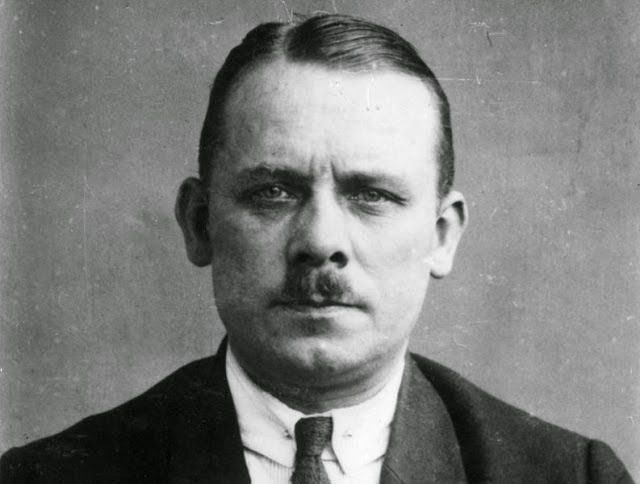
FRIEDRICH "FRITZ" HEINRICH KARL HAARMANN EL “VAMPIRO O CARNICERO DE HANNOVER”


Friedrich "Fritz" Heinrich Karl Haarmann nació el 25 de octubre de 1879 en Hannover, Alemania.  Era el sexto hijo de una familia humilde. Fritz era un niño tímido y callado, su madre lo trataba y vestía como una niña, Fritz prefería jugar con las muñecas de sus hermanas, que salir a jugar con los niños del barrio. Fritz  fue un mal estudiante por lo que a los 16 años ingresó a la academia militar de Neu Breisach, se adaptó bien a la vida militar pero al año de ingresar en la academia comenzó a sufrir ataques por lo que fue dado de baja por razones médicas. Fritz regreso a Hannover y trabajo en una fábrica de tabaco.
En 1898, fue arrestado por abusar de niños, un psicólogo declaró a Fritz no apto mentalmente para ser enjuiciado y posteriormente fue enviado a una institución mental de forma indefinida. Seis meses después Fritz se escapó y huyó a Suiza, donde estuvo dos años antes de regresar a Alemania. Se volvió a alistar en el ejército bajo un alias, pero volvió a ser dado de baja por razones médicas en 1902. Fritz recibió una pensión militar y regresó a vivir y trabajar con sus padres.

En la próxima década Fritz se convirtió en  un ladrón y estafador, frecuentemente era arrestado y tenía que cumplir cortas condenas, a causa de ello Fritz entablo relación con la policía y se convirtió en informante de esta. En 1914 Fritz fue condenado por robos y fraudes, fue encarcelado cuando comenzaba la Primera Guerra Mundial y fue liberado en 1918.

Entre 1918 y 1924, Fritz Haarmann aterrorizo a la sociedad alemana ahondando más el sufrimiento

domingo, 16 de noviembre de 2014

HANDLEY PAGE HEYFORD WAS A LAST BIPLANE BOMBER IN RAF SERVICE


The Heyford was a last biplane bomber in Royal Air Force service and even looked dated when new it’s fixed spotter landing gear doing nothing to improve its appearance. The Heyford’s wings were of metal frame with fabric covering, while the fuselage was half metal (forward) and half fabric covered. Despite this, the Heyford was the most important British bomber of the mid 1930s.

Three prototypes were ordered for evaluation in 1927, the first having its maiden flight in June 1930. Successful testing led to the type being ordered, and when production ended in July 1936, 15 Heyford Mk I, 21 Heyford Mk IA, 16 Heyford Mk II and 70 Heyford Mk III aircraft had been delivered. The